

When most people see a professional beekeeper working, they notice the suit, the veil and maybe the smoker.
But those are only part of the story.
Professional live bee removal and relocation requires specialized equipment, and every tool has a purpose. The right equipment helps protect the beekeeper and the property owner, but it can also make an enormous difference in protecting the bees themselves.
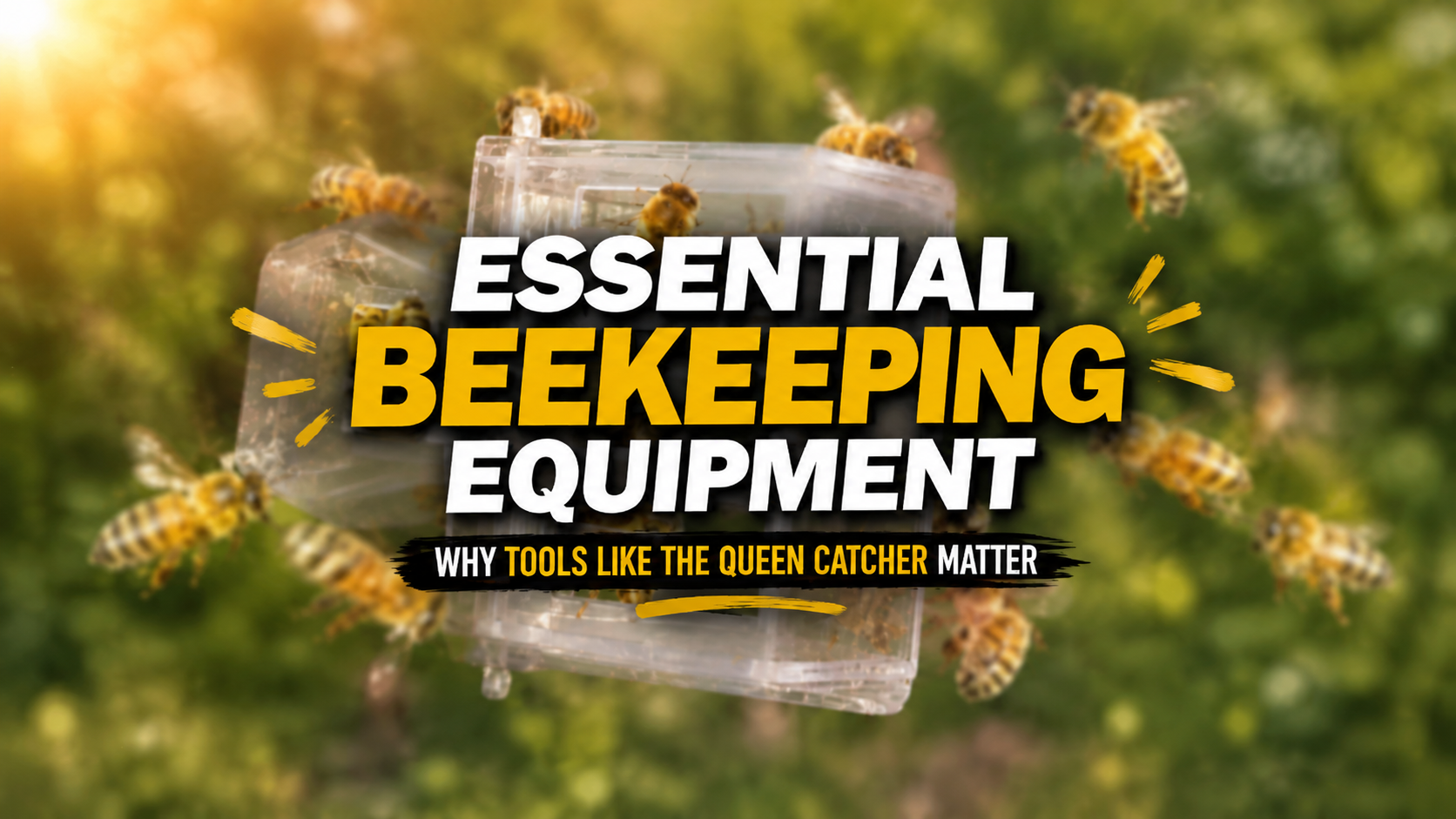
One of the most interesting tools in our equipment is the queen catcher shown in the photo and video from a recent BeeBoyz removal.
It may look like a simple plastic container, but when you understand the role of the queen, you understand why this small piece of equipment can be so important.
The Queen Catcher: Protecting the Heart of the Colony
Inside a healthy honey bee colony, the queen plays a critical role.
She is the colony’s primary reproductive female, and her pheromones help communicate her presence throughout the colony. Honey bee colonies rely heavily on this chemical communication. UF/IFAS explains that queen pheromone signals to worker bees that their queen is present, while Penn State notes that a mated queen’s pheromone contributes to the social organization of the colony.
That makes finding and protecting the queen an important part of many live removals.
What Is a Queen Catcher?
A queen catcher, sometimes referred to as a queen cage or queen clip depending on its design, temporarily contains and protects the queen while the beekeeper continues working with the colony.
The openings in the catcher provide ventilation and allow contact between the queen and surrounding worker bees while preventing the larger queen from simply walking away.
In the BeeBoyz photo, you can see worker bees gathering all around the queen catcher.
That’s exactly why locating the queen can be such an important moment during a removal.
Once she is safely contained, the beekeeper knows where one of the colony’s most important members is while the remaining bees are being collected and prepared for relocation.
Florida’s own Best Management Practices for Live Bee Removals specifically include a queen catcher/queen cage among the equipment a beekeeper may need for swarm removal.
Suggested photo caption:
BeeBoyz using a ventilated queen catcher during a live bee removal and relocation in South Florida.
Suggested image alt text:
Queen catcher surrounded by honey bees during professional live bee removal in South Florida.
Why Secure the Queen During a Bee Removal?
Imagine trying to move an entire family without knowing where the mother is.
A honey bee colony is obviously very different from a human family, but the comparison helps explain the challenge.
A beekeeper may be working with thousands or tens of thousands of moving bees. During a removal, frames, comb and bees may need to be carefully transferred into new hive equipment.
If the queen becomes injured, lost or accidentally left behind, the relocation becomes much more complicated.
Temporarily securing her allows the beekeeper to:
- Protect the queen during removal.
- Keep track of her while thousands of bees are being handled.
- Reduce the possibility of accidentally injuring her.
- Assist with moving the colony into its relocation equipment.
- Transport her safely as part of the live-relocation process.
The catcher is intended for temporary containment during handling and relocation, not as a permanent home for the queen.
VIDEO PLACEMENT
Embed the BeeBoyz queen-catcher video here.
Suggested video caption:
Watch the activity around the queen catcher during a BeeBoyz live bee removal. Specialized equipment allows our team to protect the queen while preparing the colony for relocation.
More Essential Equipment Professional Beekeepers Need
The queen catcher is one specialized piece of equipment, but professional bee removal often requires an entire collection of tools.
UF/IFAS’s Florida live-removal guidelines include protective equipment, smokers, hive boxes, bee brushes, queen catchers, bee vacuums and numerous other tools because no two removals are exactly alike.
Here are some of the tools you may see the BeeBoyz team using.
1. Bee Suit, Veil and Protective Equipment
Safety comes first.
Professional beekeepers may use:
- Bee suits or jackets
- Veils
- Beekeeping gloves
- Boots or closed-toe shoes
- Eye protection when conditions require it
UF/IFAS identifies the veil as one of the most important pieces of personal protective equipment because it protects the face, head and neck.
Even an experienced beekeeper respects the colony.
Protective equipment allows the beekeeper to work carefully instead of reacting to every bee that lands on them.
2. The Smoker
The smoker may be the most recognizable beekeeper tool.
Honey bees communicate danger partly through alarm pheromones. Properly used cool smoke can interfere with those alarm signals and help a beekeeper work around a colony with less disruption.
The key is proper use.
More smoke is not necessarily better. An experienced beekeeper watches the bees’ behavior and uses only what the situation requires.
3. Hive Tool
The hive tool looks simple, but a beekeeper can use it constantly.
Honey bees produce propolis, an extremely sticky material they use to seal small spaces inside the hive.
A hive tool helps a beekeeper:
- Separate frames
- Lift hive components
- Scrape away excess wax or propolis
- Carefully access comb
- Work through a colony without unnecessary damage
UF/IFAS describes the hive tool as one of the most useful tools available to a beekeeper.
4. Bee Vacuum
A professional bee vacuum can be extremely useful when bees are located inside walls, soffits, roofs, meter boxes or other difficult spaces.
This is not the same as grabbing a household Shop-Vac.
Equipment intended for live bee removal must be used in a way that minimizes injury to the bees while allowing the beekeeper to collect large numbers safely.
Florida’s live-removal guidelines specifically identify bee vacuums as equipment that may be used when transferring bees during swarm and established-colony removals.
5. Bee Brush
Sometimes precision is better than power.
A soft bee brush allows a beekeeper to gently move bees away from:
- Comb
- Frames
- Work areas
- Structural surfaces
It is particularly useful when the goal is to relocate the colony while causing as little harm as possible.
6. Hive Boxes, Frames and Transportation Equipment
Removing the bees is only half the job.
They need somewhere safe to go.
Professional relocation may require:
- Hive boxes
- Frames
- Bottom boards
- Lids
- Screened or ventilated containment
- Entrance-closing materials
- Straps and transportation equipment
Airflow becomes especially important during transportation in South Florida’s heat.
UF/IFAS’s live-removal guidance specifically warns against completely sealing transported bees without ventilation and notes that airflow should be maintained while preventing escape.
7. Inspection and Access Equipment
Some colonies are easy to see.
Others may be hidden deep inside:
- Attics
- Soffits
- Exterior walls
- Roof systems
- Trees
- Utility and meter boxes
- Commercial structures
Depending on the job, professional equipment may include ladders, borescopes, cameras, thermal-imaging equipment, cutting tools and other specialized equipment for locating and accessing the colony.
This is another reason bee removal should not be treated as a DIY project.
Professional Bee Removal Is More Than Showing Up With a Bee Suit
Anyone can purchase a veil or smoker online.
Knowing when, where and how to use professional beekeeping equipment comes from training and experience.
A successful live removal requires the beekeeper to think about several things simultaneously:
Where is the queen?
Where is the brood?
Where is the honey and comb?
How are the bees entering the structure?
Can the colony be safely relocated?
How will the bees be contained and transported?
What needs to happen to prevent another colony from moving into the same location?
The tools support those decisions.
They don’t replace experience.
Why Proper Equipment Matters During South Florida Bee Removal
South Florida presents its own challenges.
BeeBoyz performs removals from homes, businesses, roofs, walls, trees, soffits, meter boxes and other locations throughout Broward County, Miami-Dade County and Palm Beach County.
Florida also takes live bee removal seriously.
The Florida Department of Agriculture and Consumer Services states that registered Florida beekeepers may perform live removal and relocation of nuisance swarms and established colonies. The agency also specifically warns property owners not to attempt nuisance honey bee removal without the proper equipment and training.
That is important advice.
When thousands of bees are involved, proper equipment isn’t about looking professional.
It’s about doing the job correctly.
The Smallest Tool Can Make a Big Difference
Take another look at the BeeBoyz queen catcher in the photo.
It’s a small piece of equipment surrounded by hundreds of bees.
But inside is the individual around which much of the colony is organized.
Protecting that queen while carefully collecting the workers, comb and brood gives the colony a much better opportunity to continue somewhere safer.
That’s what professional live bee relocation is about.
Protect the people. Protect the property. And whenever conditions allow, protect the bees.
Need Professional Bee Removal in South Florida?
If you’ve discovered bees around your home or business, don’t spray the colony, block its entrance or attempt to remove it yourself.
BeeBoyz provides professional bee removal and bee relocation throughout South Florida, including Fort Lauderdale, Davie, Plantation, Pembroke Pines, Cooper City, Weston, Hollywood, Sunrise, Coral Springs, Miami, Miami Beach, Kendall, Boca Raton, Delray Beach, Boynton Beach, West Palm Beach and surrounding communities.
Our team has the experience, equipment and knowledge required to evaluate the colony and determine the appropriate removal approach.
Call BeeBoyz at 954-483-5533 for a free same-day estimate.