

Finding a large group of bees near your home or business can be frightening. You may notice bees gathering on a tree branch, entering through a hole in the roof, flying around an exterior wall or building a hive inside an attic, soffit or shed.
While the immediate concern is protecting your family, customers, employees and property, extermination is not always the only option.
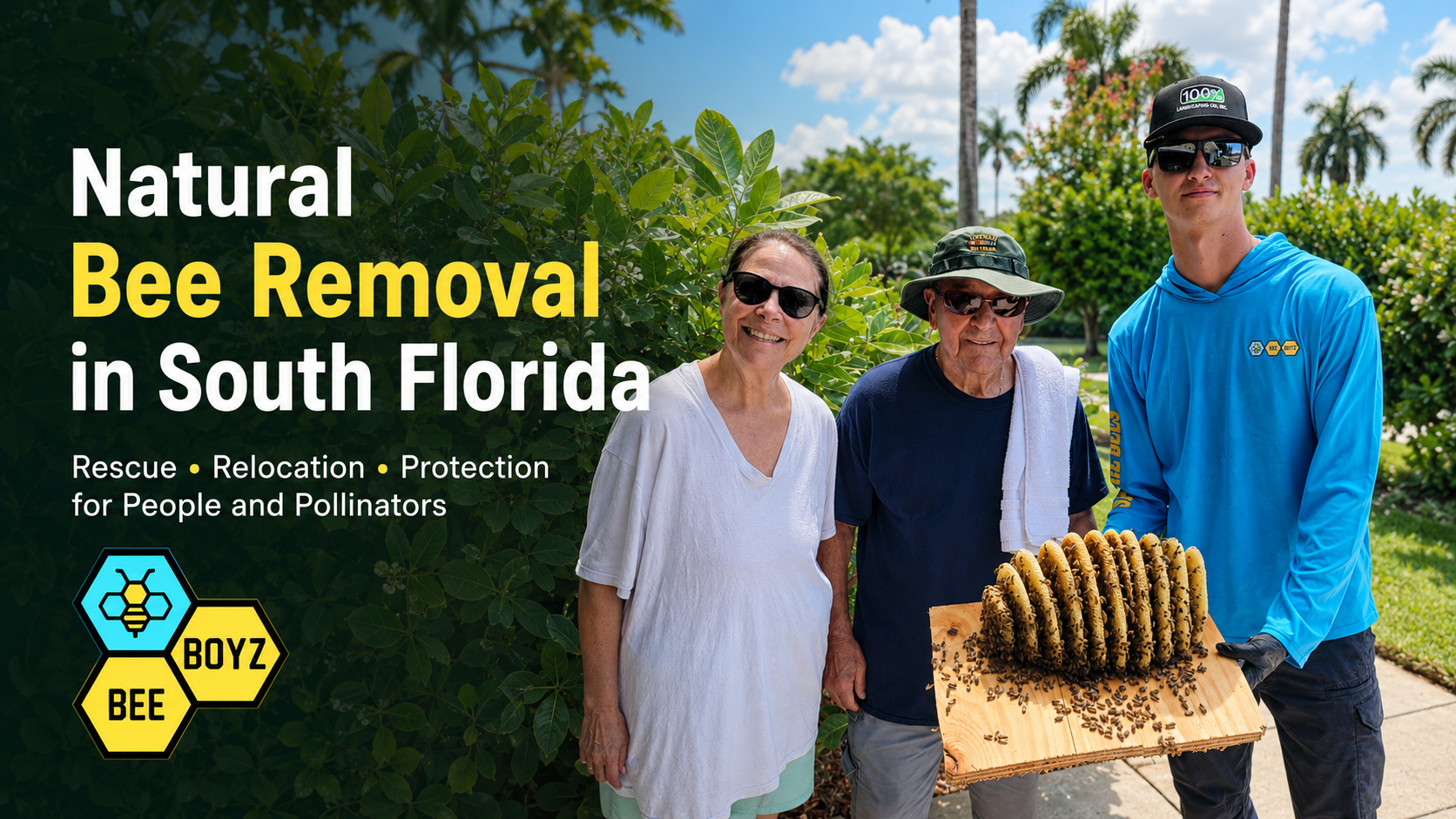
Natural bee removal, rescue and relocation offer a responsible way to remove honey bees from an unwanted location while giving the colony an opportunity to survive somewhere safer.
At BeeBoyz, we provide professional bee removal services throughout South Florida, including Miami-Dade County, Broward County and Palm Beach County. Whenever conditions make it possible, our goal is to safely remove the bees, address the hive and relocate the colony away from homes, businesses and other high-traffic areas.
What Is Natural Bee Removal?
Natural bee removal generally refers to removing bees without relying on unnecessary pesticide applications or automatically destroying the colony. Depending on the location, accessibility and temperament of the bees, the process may involve:
- Identifying the type of bee and where the colony is located
- Locating the hive, honeycomb, queen and brood
- Carefully opening the affected area when necessary
- Removing the bees and hive material
- Placing the colony into an appropriate transport container
- Relocating the bees to a managed or suitable environment
- Cleaning the cavity and removing honey or wax
- Sealing possible entry points to reduce the likelihood of another infestation
Florida allows unwanted honey bee colonies to be removed alive and repurposed as managed colonies. Florida also distinguishes between live removal and pest-control eradication, which may require different registrations or licensing depending on the work being performed.
Professional evaluation is important because every bee situation is different. A temporary swarm hanging from a tree is not handled the same way as an established hive containing honeycomb inside a wall.
Bee Swarm Versus Established Bee Colony
Bee Swarm
A swarm is usually a cluster of bees gathered around a queen while searching for a new nesting site. Swarms may appear on:
- Tree limbs
- Fences
- Mailboxes
- Vehicles
- Rooflines
- Patio furniture
- Building exteriors
A swarm may remain in place for only a short period, but people should still keep their distance. Bees can become defensive if disturbed, sprayed, struck or approached too closely.
Established Colony
An established colony has selected a protected location and begun constructing comb. Common nesting locations in South Florida include:
- Exterior walls
- Attics
- Soffits and roof cavities
- Chimneys
- Sheds
- Utility boxes
- Hollow trees
- Abandoned structures
- Pool equipment enclosures
- Commercial signs
- Concrete block cavities
Established colonies require more than simply removing the visible bees. Honeycomb, wax, honey and hive debris may also need to be removed.
Why Complete Hive Removal Matters
Removing or killing the visible bees without removing the hive can leave a significant problem behind.
Honey, wax and comb remaining inside a South Florida structure may attract ants, roaches, rodents, wax moths and other pests. Heat can also cause abandoned honey to melt and seep through ceilings, drywall or exterior surfaces.
The scent of an old hive may attract another bee colony to the same location. This is why effective bee hive removal should include an evaluation of the cavity, removal of accessible hive material and recommendations for sealing the original entry point.
A complete service may require coordination between a bee removal specialist and an experienced contractor, particularly when the hive is located behind stucco, drywall, fascia, roofing or another structural surface.
Why Bees Are Important to Florida
Honey bees and native bee species contribute to the pollination of flowering plants, gardens and agricultural crops.
Florida’s agricultural economy relies on pollination for a number of fruit and vegetable crops. Watermelons, cucurbits, blueberries and some citrus varieties can produce greater quantity and quality when properly pollinated.
Florida’s climate also supports a wide variety of nectar- and pollen-producing plants. Floral resources differ between North, Central and South Florida because of regional differences in temperature, rainfall, soil and plant communities.
Protecting pollinators supports more than honey production. Bees contribute to:
- Florida agriculture
- Residential gardens
- Flowering trees and plants
- Fruit and vegetable production
- Seed production
- Biodiversity
- Natural plant reproduction
- Local food systems
Florida agriculture and healthy pollinator populations are closely connected. Protecting both honey bee colonies and agricultural crops is an important part of responsible environmental management.
Honey Bees Are Not Florida’s Only Pollinators
It is important to recognize that honey bees are only one part of Florida’s pollinator population.
Florida is home to numerous native bee species, including bumble bees, sweat bees, leafcutter bees, mining bees and specialist bees that have developed close relationships with particular native plants.
Native bees and honey bees may both contribute to crop and plant pollination. Diverse wild bee communities can be highly effective crop pollinators.
Responsible bee management should therefore focus on protecting people and property while avoiding unnecessary harm to beneficial insects.
Why Bees Choose South Florida Properties
South Florida offers many of the conditions bees need:
- Warm temperatures
- Long growing seasons
- Flowering tropical plants
- Residential gardens
- Fruit trees
- Accessible water
- Protected wall and roof cavities
- Older buildings with structural openings
Bees frequently enter through small construction gaps around rooflines, vents, soffits, fascia boards, utility penetrations and exterior walls. Once the bees identify a protected cavity, the colony can begin constructing comb inside the structure.
This is one reason homeowners should not ignore repeated bee activity around the same opening.
A few bees visiting flowers is normal. A steady stream of bees entering and leaving a structural opening may indicate an established hive.
Benefits of Live Bee Rescue and Relocation
It Protects People and Property
Bees living inside walls, rooflines or busy outdoor areas may create a stinging risk. Professional removal moves the colony away from areas occupied by families, pets, employees or customers.
It Preserves a Productive Colony
A viable colony may be transferred into managed equipment and relocated to a more appropriate setting.
It Avoids Unnecessary Pesticide Use
Live removal may reduce the need to introduce pesticides into a wall cavity, garden or outdoor environment.
It Addresses the Source of the Problem
A thorough removal deals with the bees, comb, honey and entry point rather than treating only the insects visible outside the structure.
Is Live Bee Removal Always Possible?
Although relocation is often preferred, it may not be appropriate in every situation.
A professional must consider:
- The location of the colony
- Accessibility of the hive
- Colony temperament
- Risk to the public
- Structural conditions
- Whether the bees can be contained
- The presence of sensitive people or animals
- The possibility of Africanized honey bee characteristics
- Whether emergency conditions exist
The property owner and qualified professional must evaluate the individual circumstances. The safety of the occupants, technicians and surrounding community must remain the first priority.
Why You Should Not Attempt DIY Bee Removal
Spraying a hive entrance, blocking the opening or trying to knock down a swarm can make the situation more dangerous.
Improper treatment may:
- Agitate defensive bees
- Drive bees deeper into the structure
- Leave honey and comb inside the wall
- Expose people and pets to stings
- Cause honey leakage or property damage
- Fail to remove the queen
- Result in the bees returning
- Create legal or pesticide-compliance concerns
Do not seal an active hive entrance before the bees and hive have been properly addressed. Bees trapped inside a wall may find another route into the building.
What to Do When You Discover Bees
- Keep children and pets away from the area.
- Do not spray the bees with water, pesticides or household chemicals.
- Avoid loud equipment, vibration and sudden movements near the colony.
- Close nearby windows and doors.
- Observe the bees from a safe distance.
- Contact a professional South Florida bee removal company.
- Explain whether the bees are clustered outside or entering a structure.
- Mention any known sting allergies or immediate safety concerns.
Call emergency services when someone experiences a severe allergic reaction, breathing difficulty or another medical emergency after a sting.
Residential and Commercial Bee Removal
BeeBoyz provides bee removal, rescue and relocation services for many types of South Florida properties, including:
- Single-family homes
- Condominiums and apartment buildings
- Restaurants
- Retail centers
- Offices
- Warehouses
- Schools and churches
- Hotels
- Construction sites
- Property management communities
- Municipal and commercial properties
Commercial bee removal may require additional planning to protect customers, tenants, employees and pedestrians. The service may also need to be coordinated around business hours, property-management requirements and access to roofs or mechanical areas.
Bee Removal Throughout the South Florida Tri-County Area
Broward County Bee Removal
Our Broward County service area includes:
Coconut Creek, Cooper City, Coral Springs, Dania Beach, Davie, Deerfield Beach, Fort Lauderdale, Hallandale Beach, Hillsboro Beach, Hollywood, Lauderdale Lakes, Lauderdale-by-the-Sea, Lauderhill, Lazy Lake, Lighthouse Point, Margate, Miramar, North Lauderdale, Oakland Park, Parkland, Pembroke Park, Pembroke Pines, Plantation, Pompano Beach, Sea Ranch Lakes, Southwest Ranches, Sunrise, Tamarac, Weston and Wilton Manors.
Miami-Dade County Bee Removal
Our Miami-Dade County service area includes:
Aventura, Bal Harbour, Bay Harbor Islands, Biscayne Park, Coral Gables, Cutler Bay, Doral, El Portal, Florida City, Golden Beach, Hialeah, Hialeah Gardens, Homestead, Indian Creek, Key Biscayne, Medley, Miami, Miami Beach, Miami Gardens, Miami Lakes, Miami Shores, Miami Springs, North Bay Village, North Miami, North Miami Beach, Opa-locka, Palmetto Bay, Pinecrest, South Miami, Sunny Isles Beach, Surfside, Sweetwater, Virginia Gardens and West Miami.
We also serve unincorporated communities and neighborhoods such as Kendall, West Kendall, Coconut Grove, Country Walk, Goulds, Leisure City, Naranja, Princeton, Redland, Richmond West and Westchester.
Palm Beach County Bee Removal
Our Palm Beach County service area includes:
Atlantis, Belle Glade, Boca Raton, Boynton Beach, Briny Breezes, Cloud Lake, Delray Beach, Glen Ridge, Golf, Greenacres, Gulf Stream, Haverhill, Highland Beach, Hypoluxo, Juno Beach, Jupiter, Jupiter Inlet Colony, Lake Clarke Shores, Lake Park, Lake Worth Beach, Lantana, Loxahatchee Groves, Manalapan, Mangonia Park, North Palm Beach, Ocean Ridge, Pahokee, Palm Beach, Palm Beach Gardens, Palm Beach Shores, Palm Springs, Riviera Beach, Royal Palm Beach, South Bay, South Palm Beach, Tequesta, Wellington, West Palm Beach and Westlake.
Protect Your Property Without Forgetting the Importance of Bees
Bees do not belong inside a family’s walls, above a business entrance or next to a heavily used outdoor space. However, bees also play an important role in Florida’s environment and agricultural economy.
Natural bee removal provides a balanced solution.
The objective is to protect people, remove the immediate hazard, address the hive and preserve the colony when safe relocation is practical.
Contact BeeBoyz for Natural Bee Removal in South Florida
Do not allow a small bee problem to become a large hive inside your home or commercial property.
BeeBoyz provides professional bee removal, hive removal, bee rescue and relocation services throughout Miami-Dade County, Broward County and Palm Beach County.
Contact BeeBoyz today to schedule an inspection and learn whether natural bee removal and relocation are appropriate for your property.