
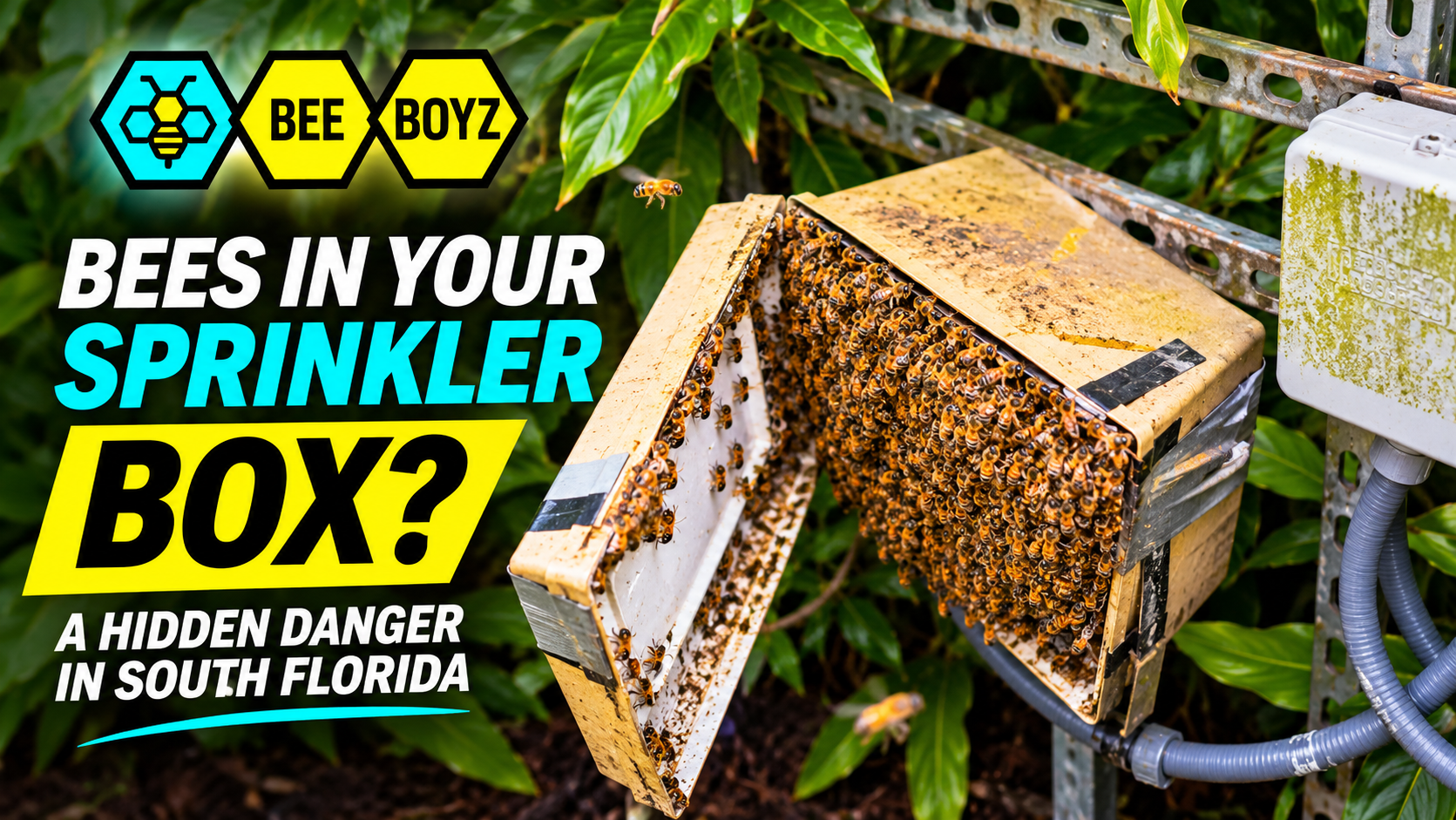

Imagine walking outside to adjust your sprinkler system, opening the irrigation control box, and discovering thousands of honey bees living inside.
What appeared to be an ordinary piece of equipment has become a fully established beehive, complete with honeycomb, stored honey, and a colony protecting its home.
In South Florida, bees can establish colonies in some of the most unexpected places. Sprinkler boxes, irrigation control panels, water meters, and electrical enclosures provide the type of shelter honey bees naturally seek when establishing a new home.
At BeeBoyz, we believe educating our community about these hidden colonies is just as important as safely removing and relocating them.
Why Do Honey Bees Nest in Sprinkler Boxes?
When a honey bee colony swarms, scout bees search for a suitable location to establish a new home. They look for protected cavities where the colony can build honeycomb, raise young bees and store food.
Sprinkler and irrigation boxes can provide several favorable conditions:
- Dark, enclosed spaces
- Protection from wind and rain
- Small openings that allow bees to enter and exit
- Shelter from direct sunlight and extreme weather
- Limited human interference
- Proximity to flowering plants and other food sources
Many South Florida irrigation systems are also surrounded by tropical landscaping, making these enclosures easy to overlook.
The University of Florida’s Institute of Food and Agricultural Sciences (UF/IFAS) identifies irrigation valve boxes, electrical enclosures and water meter boxes as potential nesting locations for Africanized honey bees in Florida.
Unlike colder regions, South Florida’s subtropical climate allows honey bee colonies to remain active throughout much of the year. Homeowners should remain alert even during the fall and winter months.
A Look Inside a South Florida Irrigation Box
The photographs accompanying this article demonstrate just how extensively honey bees can occupy a small outdoor enclosure.
Once the box was opened, a dense colony of honey bees could be seen covering the interior. Honeycomb and honey had accumulated inside the enclosure, surrounding components of the irrigation system.
The photographs taken after the comb was removed reveal electrical wiring, connections and other components that had been concealed behind the colony.
This is an important reminder that what you see outside an irrigation box may represent only a small portion of the colony living inside.
A handful of bees entering and exiting a small opening could be an indication of a much larger colony.
Can Bees Damage Your Sprinkler System?
Yes, a honey bee colony can potentially interfere with irrigation equipment, particularly when it establishes itself inside an electrical control enclosure.
As the colony grows, honeycomb, beeswax and honey can accumulate around wiring and other components.
Potential problems include:
- Obstructed access to irrigation controls
- Honey and wax accumulating around electrical connections
- Difficulty inspecting or servicing equipment
- Secondary pest infestations involving ants, beetles and other insects
- Potential equipment contamination or malfunction
- Increased maintenance and repair costs
Even after the bees have been removed, leaving honeycomb and honey behind can create additional problems and attract other insects.
Any affected electrical equipment should be inspected by a qualified electrician or irrigation technician before being returned to service.
Are Bees in Sprinkler Boxes Dangerous?
Honey bees are essential pollinators and play an important role in our environment. However, an established colony may become defensive when it perceives a threat.
South Florida is also home to Africanized honey bees, which can exhibit stronger defensive behavior than European honey bees.
Unfortunately, it is not possible to reliably distinguish Africanized honey bees from European honey bees simply by looking at them.
Activities that could disturb a hidden colony include:
- Opening an irrigation box
- Mowing the lawn
- Using a weed trimmer or leaf blower
- Trimming surrounding bushes
- Performing sprinkler repairs
- Moving or striking the enclosure
The vibrations produced by landscaping equipment may also trigger a defensive response.
This creates a particular concern for homeowners, children, pets, landscapers, maintenance workers and irrigation technicians.
Five Signs You May Have Bees Inside Your Sprinkler Box
You do not need to open an irrigation box to determine whether bees may be living inside.
Watch for these warning signs from a safe distance:
1. Consistent bee activity
Multiple bees repeatedly flying into and out of the same opening.
2. Buzzing sounds
A noticeable humming or buzzing coming from inside the enclosure.
3. Bees gathering around the lid
Bees clustering around the edges, seams or openings of the box.
4. Visible honey or beeswax
Sticky residue or wax appearing around the enclosure.
5. Unusual activity around landscaping equipment
Bees becoming defensive when mowing, trimming or other maintenance takes place nearby.
If you notice any of these signs, avoid investigating further and contact a bee removal professional.
What Should You Do If You Find Bees in Your Irrigation Box?
Discovering a colony does not mean the bees need to be killed. However, it does mean the situation should be handled carefully.
- Do not open or disturb the sprinkler box.
- Do not spray the bees with pesticides or water.
- Do not attempt to smoke the bees out.
- Do not seal the entrance while bees are inside.
- Do not operate landscaping equipment near the colony.
- Keep children, pets and maintenance workers away.
- Contact a professional bee removal company.
Because irrigation control boxes may contain energized electrical components, attempting to remove a colony yourself can introduce both stinging and electrical hazards.
If bees begin pursuing or stinging you, move quickly into an enclosed building or vehicle. Call 911 if someone experiences a severe allergic reaction or is overwhelmed by multiple stings.
How BeeBoyz Safely Removes Bees From Sprinkler Boxes
At BeeBoyz, our goal is to protect people, property and the honey bee population through responsible bee removal and relocation whenever conditions permit.
Our approach to irrigation box bee removal includes:
Assessing the colony
We evaluate the location, accessibility, size and behavior of the colony, along with any surrounding safety concerns.
Coordinating safe access
When electrical components are involved, the equipment may need to be safely de-energized by a qualified professional before removal can proceed.
Removing the bees and queen
Whenever live relocation is appropriate, we work to safely collect the colony and its queen.
Removing honeycomb and honey
Removing the remaining hive material is an important part of addressing the problem and reducing the potential for secondary pest activity.
Relocating the colony
When the colony can be safely rescued, the bees are transported to a suitable managed environment where they can continue their important work as pollinators.
Recommending preventive measures
We identify potential entry points and recommend appropriate measures to help prevent future colonies from establishing themselves in the same location.
According to the Florida Department of Agriculture and Consumer Services, registered Florida beekeepers can perform live honey bee removals and relocate suitable colonies to managed apiaries.
How to Prevent Bees From Nesting in Your Sprinkler Box
Although no outdoor property can be guaranteed to remain bee-free, regular maintenance can reduce the likelihood of unwanted colonies.
Consider the following preventive measures:
- Visually inspect irrigation equipment regularly.
- Replace damaged or deteriorating enclosure covers.
- Have a qualified technician address unnecessary openings without interfering with drainage, ventilation or equipment access.
- Keep excessive vegetation away from irrigation equipment.
- Encourage landscaping crews to report unusual bee activity.
- Schedule professional inspections when a colony is suspected.
Never attempt to seal an opening if bees are already entering or exiting the enclosure. The colony should be professionally addressed before preventive repairs are made.
An Important Reminder for HOAs, Landscapers and Property Managers
Sprinkler boxes are found throughout South Florida residential communities, commercial properties, golf courses, parks and public spaces.
Because these systems are often located near sidewalks, parking areas, playgrounds and common areas, an undetected bee colony can become a public safety concern.
Property managers and landscaping companies should incorporate visual bee activity checks into their routine maintenance procedures.
Identifying a colony early can help protect employees, residents and visitors while reducing the likelihood of an unexpected encounter.
Frequently Asked Questions
Will bees eventually leave my sprinkler box on their own?
A temporary swarm may move on, but an established colony that has built honeycomb and begun raising young bees may remain for an extended period. Professional removal is recommended when a colony occupies irrigation equipment.
Are bees attracted to sprinkler water?
Honey bees need water, but the primary attraction of a sprinkler enclosure as a nesting site is typically the protected cavity it provides rather than the water itself.
Can bees return after they have been removed?
Yes. Remaining honeycomb, hive odors and accessible entry points may attract other bees. Proper removal, cleanup and preventive maintenance can help reduce this risk.
Can bees be removed without killing them?
In many situations, yes. Professional live bee removal allows suitable honey bee colonies to be rescued and relocated to a managed environment. The safety and condition of the colony must be evaluated first.
Can bees nest in underground sprinkler valve boxes?
Yes. Both underground irrigation valve boxes and above-ground irrigation control enclosures can provide suitable nesting cavities for honey bees.
Professional Sprinkler Box Bee Removal in South Florida
For years, BeeBoyz has provided professional bee removal services throughout South Florida, helping homeowners and businesses address unwanted bee colonies while prioritizing humane relocation whenever possible.
We serve Broward, Miami-Dade and Palm Beach counties, including Fort Lauderdale, Davie, Plantation, Weston, Pembroke Pines, Cooper City, Hollywood, Coral Springs, Miami, Boca Raton and surrounding communities.
If you notice bees entering your sprinkler box, irrigation control panel, water meter or electrical enclosure, do not wait until someone accidentally disturbs the colony.
Protect your family. Protect your property. Preserve the bees.
Contact BeeBoyz today at 954-483-5533 to request a free estimate.
Visit us at www.beeboyzcontractorsinc.com.