

When something starts flying around your home, porch, roofline, soffit, or backyard, most people call it “bees.”
But not every stinging insect is a honey bee.
In South Florida, homeowners often confuse honey bees, wasps, and yellow jackets, especially when they see activity near the house and need to decide whether it’s dangerous or whether removal is needed.
Knowing the difference matters.
Some insects may simply be foraging near flowers. Others may be building nests inside soffits, rooflines, walls, sheds, meter boxes, or landscaping. While all stinging insects deserve caution, handling a honey bee colony is different from handling a wasp or yellow jacket problem.
At Bee Boyz Contractors Inc., we help South Florida homeowners identify what they’re seeing and decide the safest next step.
Why Identification Matters
If you misidentify the insect, you may also choose the wrong solution.
For example:
- A honey bee colony inside a wall or soffit may require structural hive removal.
- A paper wasp nest under an eave may be a very different issue.
- A yellow jacket nest can become aggressive and may require immediate caution.
The more accurately you identify the insect, the better you can protect your family, avoid disturbing an active nest, and get the right professional help.
What Does a Honey Bee Look Like?
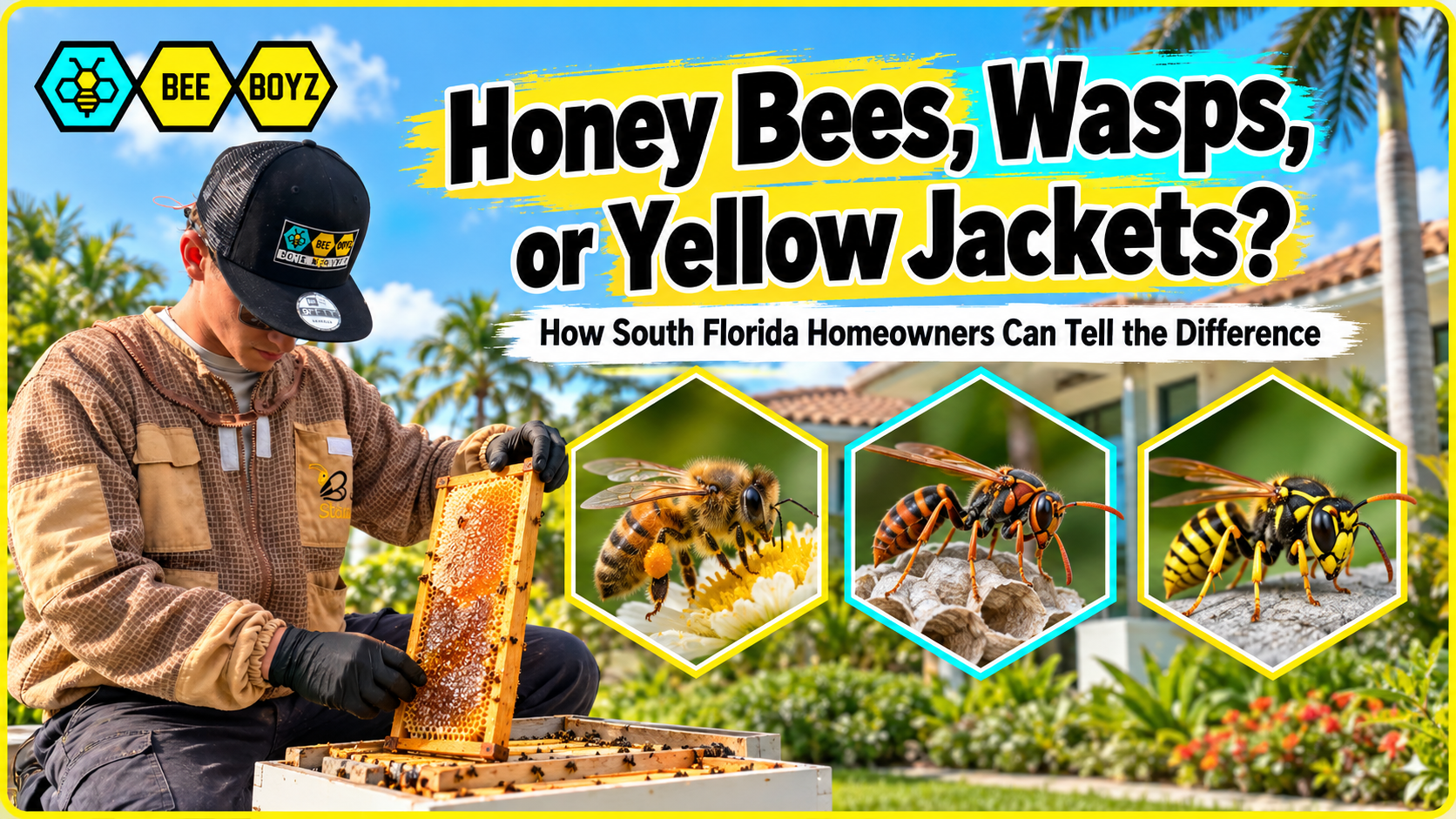
Honey bees are usually golden brown to amber, with darker bands across the abdomen. They tend to have a fuzzy or hairy body, especially around the thorax, and often look thicker or rounder than wasps.
Common Honey Bee Characteristics
- Fuzzy or hairy body
- Golden brown or amber coloring
- Dark stripes rather than bright neon yellow markings
- Thicker, less narrow waist than a wasp
- Often seen around flowers collecting pollen
- May have pollen visible on their hind legs
Honey bees focus on foraging and are less likely to bother people when left alone. However, they can become defensive if their colony is threatened.
Where You Might See Honey Bees in South Florida
- Around flowers, shrubs, and trees
- Entering soffits, walls, rooflines, and attics
- Near sheds, fences, or hollow voids
- Swarming temporarily on tree branches or structures
If you see steady traffic entering and exiting the same structural opening, there is a good chance you may be dealing with a honey bee colony.
What Does a Wasp Look Like?
Wasps usually have a more slender body, a narrower waist, and a smoother, less fuzzy appearance than honey bees.
They tend to look sharper, longer, and more streamlined.
Common Wasp Characteristics
- Smooth body with very little visible hair
- Thin, narrow waist
- Longer legs that may hang down in flight
- Often reddish-brown, black, or dark orange depending on species
- More streamlined than a honey bee
- Frequently build visible paper-like nests
Many South Florida homeowners notice wasps building nests under roof edges, patio covers, lanai corners, carports, sheds, or outdoor fixtures.
Where You Might See Wasps
- Under eaves and overhangs
- On porch ceilings or light fixtures
- Around patio furniture and sheds
- In bushes, branches, or outdoor structures
A wasp problem is often easier to spot because the nest may be visible and exposed.
What Does a Yellow Jacket Look Like?
Yellow jackets are often mistaken for bees because of their yellow-and-black coloring, but they are actually a type of wasp.
Unlike honey bees, yellow jackets have a smooth, shiny body and a brighter, more intense yellow appearance.
Common Yellow Jacket Characteristics
- Bright yellow and black coloring
- Smooth body, not fuzzy
- Narrow waist
- Sleek, fast-moving appearance
- More aggressive behavior around food and disturbances
Yellow jackets can be especially noticeable during outdoor meals, around trash, or near sweet drinks and food.
Where You Might See Yellow Jackets
- Around garbage cans
- Near outdoor food and drinks
- Around openings in the ground or wall voids
- Around eaves or nesting cavities
Because yellow jackets can be more aggressive than honey bees, homeowners should avoid disturbing the nest or trying to remove it themselves.
Quick Comparison: Honey Bee vs. Wasp vs. Yellow Jacket
Honey Bee
- Fuzzy body
- Brownish-gold coloring
- Pollen often visible on legs
- Commonly found on flowers
- Can colonize walls, roofs, soffits, and cavities
Wasp
- Smooth body
- Slender waist
- Longer legs
- Often builds exposed paper nests
- Frequently nests under eaves and overhangs
Yellow Jacket
- Smooth, shiny body
- Bright yellow and black stripes
- More compact than some wasps
- Often more aggressive
- May nest in wall voids, cavities, or other protected areas
Behavior Differences Homeowners Should Notice
Sometimes body shape alone is not enough. Behavior can also offer clues.
Honey Bees
Honey bees are often busy traveling back and forth from a flower source or colony. If a colony is established, you may notice repeated entries and exits through one small opening.
Wasps
Wasps are often seen flying solo or hovering around visible nesting spots. Their nests are more often exposed rather than hidden inside comb-filled cavities.
Yellow Jackets
Yellow jackets may be more aggressive around food and can react quickly if their nesting area is disturbed.
Are Honey Bees More Valuable Than Wasps?
Honey bees are important pollinators, which is one reason proper identification matters.
Not every stinging insect should be treated the same way.
If the issue is a honey bee colony, the goal may be to properly remove the hive from the structure and address the affected area rather than simply reacting to the bees you see.
At the same time, homeowners should never assume that an insect is harmless just because it might be a bee. Treat any stinging insect problem near your home carefully.
Common Places South Florida Homeowners Find These Insects
In South Florida, homeowners commonly find bees, wasps, or yellow jackets in and around:
- Rooflines
- Soffits
- Attics
- Exterior walls
- Sheds
- Fences
- Tree branches
- Mailboxes
- Utility boxes
- Outdoor lighting
- Patio covers
- Garbage areas
Our warm climate keeps insect activity steady for much of the year, so people in Broward, Miami-Dade, and Palm Beach counties often see activity well beyond the summer months.
What You Should Not Do
If you see bee or wasp activity around your home, avoid doing the following:
- Do not spray unthinkingly into an opening
- Do not seal the hole while insects are active
- Do not knock down a visible nest without protection
- Do not climb onto the roof to investigate
- Do not assume the insects will simply go away on their own
These actions can worsen the situation and may make insects defensive or drive them deeper into the structure.
When Should You Call a Professional?
You should call a professional if:
- You see insects entering the same opening repeatedly
- There is a nest near an entryway, patio, or high-traffic area
- You hear buzzing in a wall, soffit, or ceiling
- You find bees or wasps inside your home
- You are not sure what type of insect you are dealing with
- Someone in the household may be sensitive or allergic to stings
The sooner the issue is identified, the easier it usually is to determine the safest solution.
BeeBoyz Can Help Identify What You’re Seeing
At BeeBoyz Contractors Inc., we know most homeowners aren’t trying to become insect experts. They want to know:
What is it?
Is it dangerous?
And what should I do next?
That’s where we come in.
If you’re not sure whether you’re dealing with honey bees, wasps, or yellow jackets, we can help you evaluate the situation and point you toward the right next step.
Need Help Identifying Bees or Wasps Around Your Home?
If you’re seeing flying insects around your roofline, soffit, wall, shed, or backyard, don’t guess.
Send BeeBoyz Contractors Inc. a photo or short video of the insect activity, and we’ll help you identify what you may be dealing with.
If removal is needed, we can help guide you through the next step safely.
Contact BeeBoyz Contractors Inc.
Serving South Florida, including Broward, Miami-Dade, and Palm Beach counties