
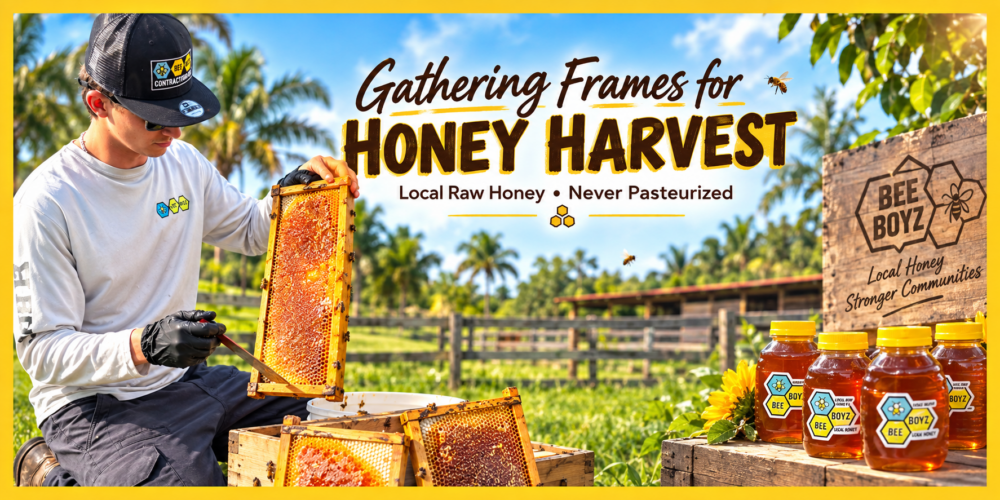

There is something special about opening a hive, pulling out a frame heavy with capped honey, and knowing that the bees have spent weeks building every cell.
At Bee Boyz, gathering honey frames is one of the most rewarding parts of beekeeping, but it is also a process we take seriously. Good honey starts long before a bottle is filled. It begins with healthy bees, properly managed hives, careful harvesting, and a commitment to keeping the honey as close to its natural state as possible.
Step 1: Letting the Bees Do the Work
Honey starts with the bees.
Worker bees collect nectar from flowers and bring it back to the hive. Inside the hive, the nectar is passed between bees and deposited into honeycomb cells. The bees reduce the moisture content by moving air across the comb with their wings.
As the nectar thickens and matures, it becomes honey.
Once the honey reaches the right moisture level, the bees seal the cells with a thin layer of wax. This is called capped honey, and it is one of the signs beekeepers look for when deciding whether a frame is ready to harvest.
Step 2: Selecting the Right Frames
We do not simply pull every frame out of a hive.
A beekeeper has to inspect the colony and determine which frames contain mature honey that is ready for harvesting.
The frames you see in our photos are full of honeycomb created and filled by the bees themselves. When we gather them, we are looking for properly capped honey and making sure we are not taking more than the colony can afford to lose.
That is an important part of responsible beekeeping.
The bees always come first.
Step 3: Removing the Honey Frames
Once the proper frames are identified, they are carefully removed from the hive.
We gently clear the bees from the frames and transport the honeycomb to the extraction area.
This part of the process requires patience. Honey frames can be heavy, sticky, and covered with bees, so careful handling protects both the colony and the comb.
Every frame represents thousands of trips made by worker bees collecting nectar throughout the local area.
Step 4: Uncapping the Honeycomb
Before honey can be extracted, the wax covering the honey cells has to be removed.
Using an uncapping tool or knife, the thin wax caps are carefully taken off the surface of the comb.
Underneath is the finished honey.
This is one of the best moments of the harvest because you can immediately see the rich color of the honey stored inside the frame.
Depending on the flowers the bees have been visiting, local honey can vary in color, aroma, and flavor throughout the year.
Step 5: Extracting the Honey
The uncapped frames are placed into a honey extractor.
An extractor spins the frames and uses centrifugal force to pull the honey from the honeycomb.
The honey runs down the walls of the extractor and collects at the bottom.
One of the advantages of this method is that much of the honeycomb structure remains intact. The empty frames can often be returned to the bees, allowing them to refill the comb rather than rebuilding everything from scratch.
Step 6: Straining the Honey
Freshly extracted honey may contain small pieces of beeswax or other natural material from the hive.
The honey is strained to remove those larger particles while keeping the product close to its natural form.
At Bee Boyz, our goal is not to turn honey into a heavily processed product.
We want local honey to still look, taste, and feel like honey from the hive.
Step 7: Bottling Local Raw Honey
After extraction and straining, the honey is ready to be bottled.
Bee Boyz honey is local, raw, and never pasteurized.
Pasteurization uses high heat to process honey. We prefer to avoid unnecessary high-temperature processing so the honey remains as close as practical to the state it was in when it came from the hive.
Raw honey naturally contains compounds such as enzymes, antioxidants, pollen, organic acids, and other naturally occurring components. The exact composition varies depending on floral source, season, location, and how the honey is handled.
And because our bees forage locally, each harvest can reflect the plants and flowers growing around our South Florida communities.
Why Local Honey Is Different
Honey is not a factory-made product.
Every hive and every harvest can be slightly different.
One batch may be lighter and floral. Another may be darker, richer, or stronger depending on what was blooming when the bees collected the nectar.
That variation is part of what makes genuine local honey special.
When you buy Bee Boyz honey, you are getting honey produced by bees living and foraging right here in our local environment.
The Bee Boyz Approach: Integrity From Hive to Bottle
For us, producing honey is not simply about filling bottles.
It is about responsible beekeeping.
We believe integrity means taking care of the colony first, harvesting only when the honey is ready, handling the frames carefully, avoiding unnecessary processing, and being transparent about where our honey comes from.
There are no shortcuts inside a beehive.
The bees determine the pace.
Our job as beekeepers is to respect that process.
From maintaining the colonies to gathering the frames, uncapping the comb, extracting the honey, straining it, and finally filling the bottles, every step matters.
That is why we are proud to call it Bee Boyz local raw honey.
From Our Hives to Your Home
The next time you look at a bottle of honey, remember how much work went into it.
Thousands of bees.
Millions of flowers.
Countless trips from flower to hive.
And finally, a beekeeper carefully gathering those golden frames.
Local bees. Local honey. Harvested with care.
Bee Boyz — Local Honey. Stronger Communities.
Need Honey? Call us 954-483-5533