
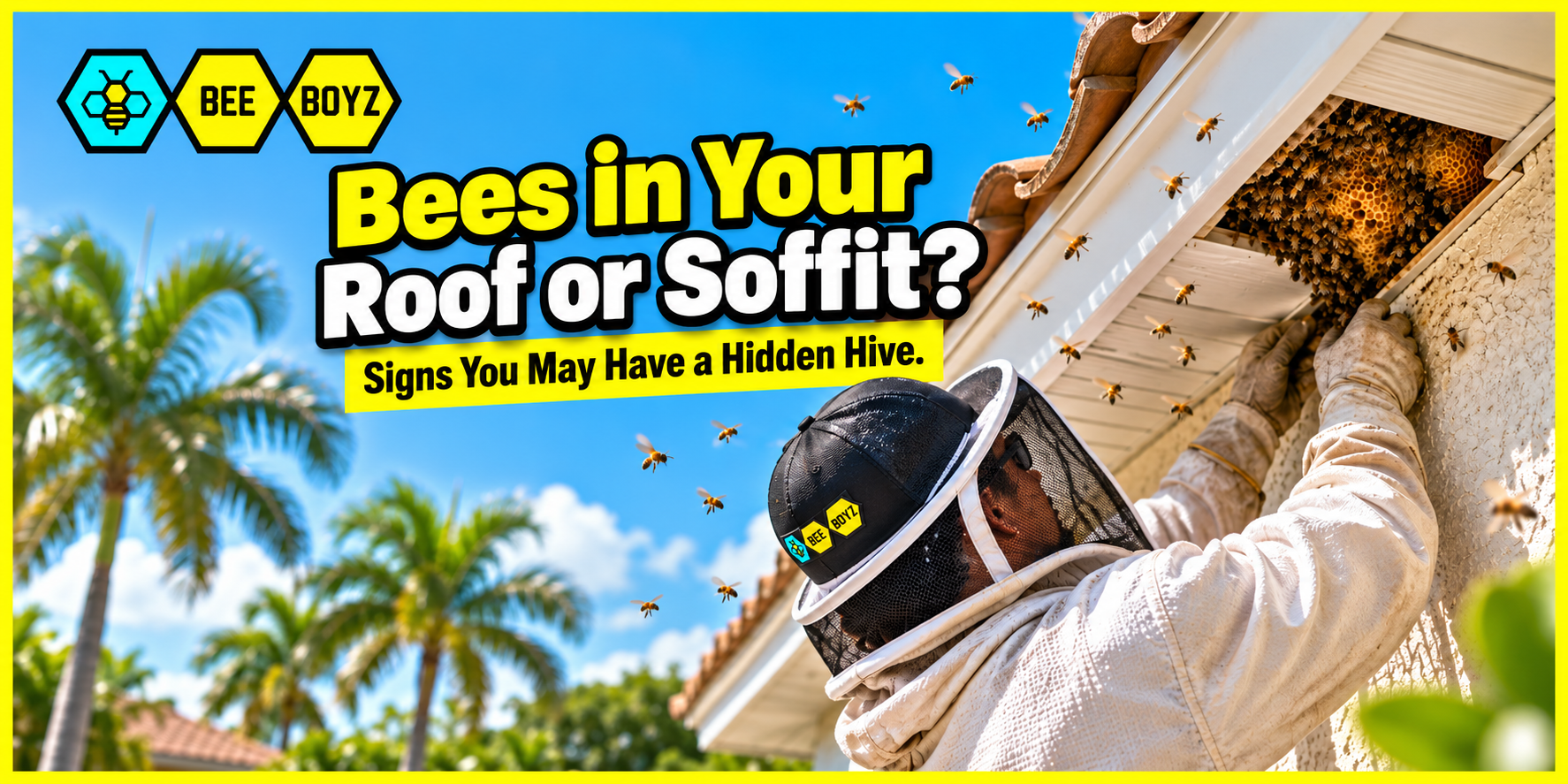

A South Florida Homeowner’s Guide to Identifying Hidden Bee Colonies and Knowing When to Call a Professional
A few bees flying around your roof might not seem like a big deal. But what happens when you notice them entering the same small opening beneath your roofline every day?
You could have a hidden beehive.
In South Florida, honey bees can establish colonies inside roof cavities, soffits, attics, and other protected spaces around a home. These areas offer shelter from rain, wind, and other environmental conditions, making them attractive nesting locations.
The problem is that homeowners often don’t realize a colony has moved in until bee activity increases, buzzing becomes noticeable, or honey begins seeping through a wall or ceiling.
At Bee Boyz Contractors Inc., we want homeowners to recognize the warning signs before a hidden hive becomes a more complicated removal project.
1. Bees Are Entering and Exiting the Same Spot on Your Roof
One of the most recognizable signs of a hidden hive is consistent bee traffic around a particular opening.
You might notice bees disappearing beneath roof tiles, entering a gap in the soffit, or flying into a small crack near your attic.
Watch from a safe distance. If you notice bees repeatedly entering and exiting the same location, particularly throughout the day, it could indicate an established colony.
Common entry points include:
- Gaps between roof tiles and exterior walls
- Damaged or loose soffit panels
- Openings around attic vents
- Cracks in stucco near the roofline
- Gaps around fascia boards and eaves
- Openings around utility lines or exterior fixtures
Even a relatively small opening can provide access to a much larger concealed cavity.
Important: Do not climb onto your roof or approach an active entry point to investigate. A professional can inspect the area using appropriate equipment and safety procedures.
2. You Hear Buzzing Inside Your Ceiling or Attic
Have you ever heard a faint humming sound coming from your ceiling or roof but couldn’t determine where it was coming from?
An established honey bee colony can produce an audible buzzing sound, particularly when the bees are concentrated in an enclosed space.
The sound may be more noticeable near the ceiling, around attic access points, or in rooms directly beneath an occupied roof cavity.
However, not every hive produces an easily recognizable sound. The absence of buzzing does not necessarily mean your home is free of bees.
If you hear persistent buzzing accompanied by bee activity around your roofline, schedule a professional inspection.
3. Honey or Dark Stains Appear on Your Ceiling or Walls
Honey bees build wax comb to raise their young and store honey and pollen.
When a colony establishes itself inside a roof or soffit, the comb may expand within the available cavity.
Over time, leaking honey or moisture associated with hive material may contribute to staining or damage to nearby building materials.
Possible warning signs include sticky residue, unusual discoloration, or honey-like liquid appearing near an affected ceiling or wall.
These signs are not exclusive to beehives. Roof leaks, plumbing problems, and other moisture-related issues can produce similar symptoms.
However, if staining appears alongside consistent bee activity around your roof, a hidden colony should be considered.
Why it matters: Removing the visible bees without addressing the comb and stored honey can leave material behind that attracts pests, creates odors, or causes additional damage.
4. You Notice Bees Inside Your Home
Finding an occasional bee indoors doesn’t automatically mean you have a colony in your attic.
But if bees repeatedly appear around ceiling fixtures, attic access panels, windows, or ventilation openings, it may indicate that they are entering the living space from a nearby cavity.
This is particularly concerning when you are also seeing bees entering the exterior roofline.
Avoid opening the attic to investigate or attempting to locate the hive yourself.
Keep children and pets away from the affected area and contact a professional bee removal service.
5. Bee Activity Continues for Days or Weeks
There is a difference between bees temporarily gathering around your home and a colony establishing a permanent nesting location.
A swarm may rest on a tree, fence, or other exposed surface while scout bees search for a suitable home.
Once bees settle inside a protected cavity, they can begin constructing comb and establishing their colony.
If you see bees consistently using the same roof or soffit opening over several days, the colony may already be established.
The sooner the situation is evaluated, the easier it may be to address before the colony grows and expands its comb.
Why Are South Florida Roofs and Soffits Attractive to Bees?
South Florida’s warm climate allows honey bees to remain active throughout much of the year.
Unlike colder regions, where winter temperatures significantly reduce outdoor bee activity, South Florida can experience bee activity even during the fall and winter months.
Our homes also have structural features that can provide desirable nesting spaces.
Roof cavities, soffits, fascia gaps, attic spaces, and enclosed areas beneath roofing materials may offer shelter and protection.
Homes in Fort Lauderdale, Davie, Plantation, Coral Springs, Miami, Boca Raton, and other South Florida communities can experience these problems regardless of the season.
Regularly checking your home’s exterior for damage and potential entry points can help reduce the likelihood of a colony moving in.
What Happens If You Leave a Beehive in Your Roof?
An established colony may continue growing and building comb within the available cavity.
As the hive becomes larger, removal can become more involved.
Potential complications include accumulating honey and wax, staining of surrounding materials, increased bee activity near doors or outdoor living spaces, and bees finding pathways into occupied areas of the home.
An abandoned or improperly removed hive may also attract insects and other pests.
A professional inspection can help determine where the colony is located, whether comb has been established, and what removal work may be necessary.
Why You Should Never Spray or Seal a Hidden Beehive
When homeowners discover bees entering their roof, their first instinct may be to spray the opening or seal it shut.
Neither approach addresses the full problem.
Sealing an active entrance can trap bees inside the structure and cause them to search for alternative exits, potentially leading them into your living space.
Spraying an inaccessible colony can also leave dead bees, comb, honey, and other hive material inside the roof cavity.
These materials can attract pests and create additional cleanup problems.
Do not attempt to remove roof tiles, open soffit panels, or disturb the colony without professional assistance.
How Does Professional Roof and Soffit Bee Removal Work?
Every hive is different. Removing bees from beneath roof tiles requires a different approach than removing an exposed swarm from a tree.
Professional removal generally involves several important steps.
Locating the colony: The technician examines bee traffic, entry points, and accessible areas to determine where the bees have established their hive.
Developing a removal plan: The technician evaluates the roof or soffit construction and determines how to access the colony while minimizing unnecessary disturbance to the structure.
Removing the bees and hive material: Depending on the location and circumstances, removal may involve carefully accessing the cavity, collecting the bees, and removing accessible comb, honey, and other hive material.
Cleaning and prevention: Once removal is complete, the affected space can be cleaned as appropriate, and potential entry points can be addressed to help discourage future colonies.
Some situations also require structural repairs or coordination with a roofing professional.
At Bee Boyz Contractors Inc., we recognize that successful structural bee removal involves more than addressing the bees you can see.
Understanding the building, locating the hive, and addressing the affected cavity are important parts of the process.
How Can You Help Prevent Bees From Nesting in Your Roof?
Although no preventive measure can guarantee that bees will never settle near your home, routine maintenance can help reduce potential nesting opportunities.
Inspect your home’s exterior periodically for damaged soffit panels, loose fascia boards, missing vent screens, and cracks around the roofline.
Have damaged areas repaired and suitable openings sealed after confirming that no bees or other animals are occupying the cavity.
If you notice repeated bee activity around a particular area, arrange an inspection before performing repairs.
Never seal an opening while an active colony is inside.
NEED PROFESSIONAL BEE REMOVAL?
Seeing Bees Around Your Roof or Soffit? Call Bee Boyz!
Don’t wait until a hidden hive becomes a larger problem inside your home.
If you notice bees entering your roofline, soffit, attic, walls, or another part of your property, Bee Boyz Contractors Inc. can help you determine the next step.
Our South Florida bee removal team understands the challenges of locating and removing colonies from residential structures.
Send us a photo or video of the bee activity, or contact us to schedule a professional bee removal inspection.
BeeBoyz Contractors Inc.
Serving South Florida, including Broward, Miami-Dade, and Palm Beach counties. Calll us for help: 954-483-5533