
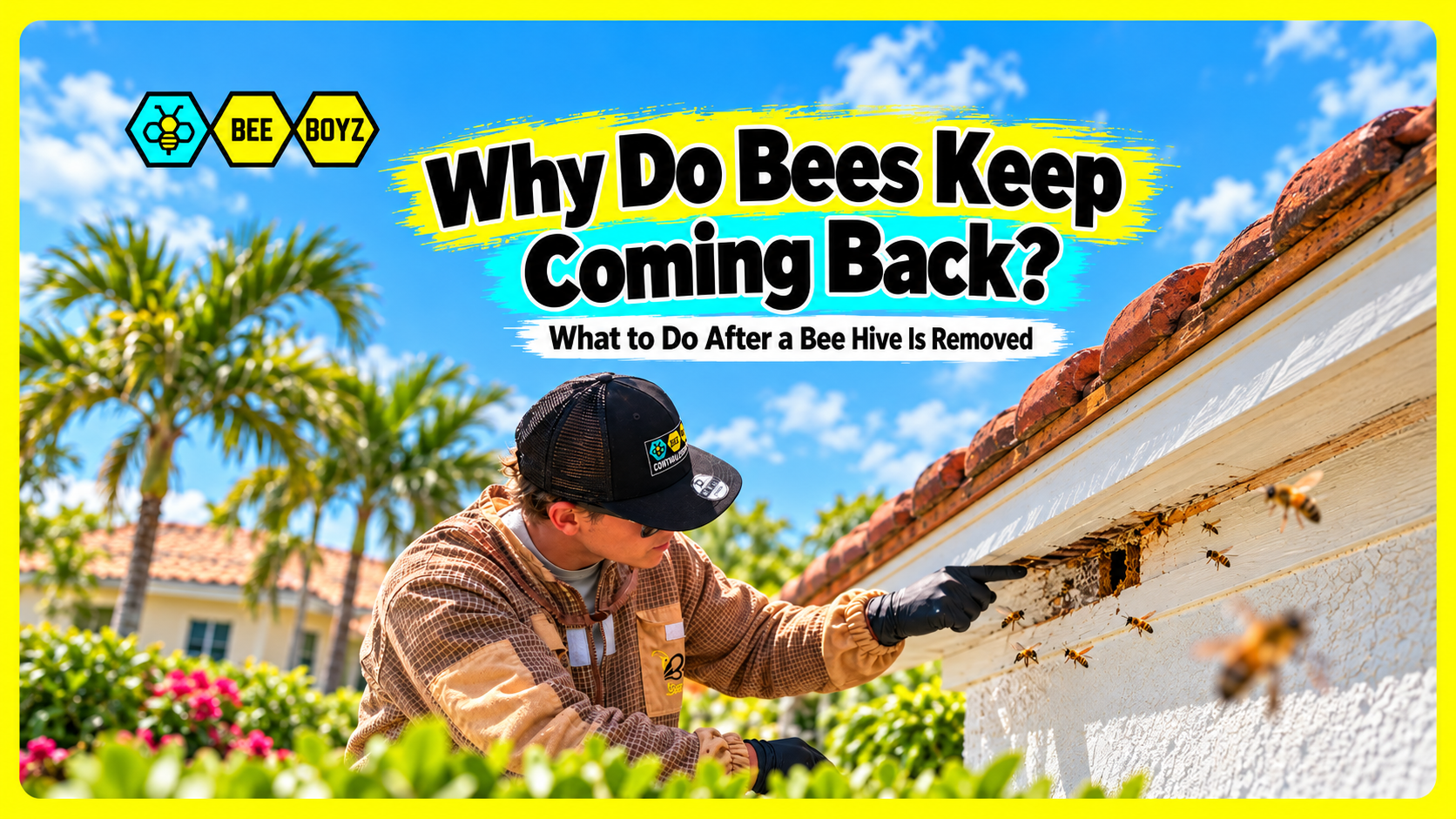

You had the bees removed. The activity stopped. Then a few weeks or months later, they came back.
For South Florida homeowners, this is more common than many people realize.
If a bee problem keeps returning to the same wall, soffit, roofline, attic, or exterior opening, there is usually a reason. In many cases, the original removal addressed the visible bees but did not fully address the hive material, scent, access point, or structure.
At BeeBoyz Contractors Inc., we see bee removal as more than just getting rid of the bees you can see.
The real goal is to understand why they were there, remove the colony properly, and reduce the chances of another swarm moving back into the same space.
Why Do Bees Return to the Same Place?
Honey bees are extremely good at finding protected cavities.
A wall void, soffit, roof cavity, attic, shed, or meter box can provide exactly what a colony needs: shelter, warmth, and weather protection.
If a previous hive occupied that space, the area may still contain things that attract future bee activity.
That is why recurring bee problems often happen in the same location.
Reason #1: Honeycomb Was Left Behind
One of the biggest reasons bees return is leftover comb.
Inside an established hive, bees build wax comb to store honey, pollen, and brood.
If the bees are removed but the comb remains inside the wall or roof cavity, that material can continue to create problems.
Old comb can:
- Hold honey
- Retain hive scent
- Attract insects and other pests
- Create odors
- Melt or leak in extreme heat
- Make the cavity attractive to future bee colonies
In South Florida’s warm climate, leaving hive material behind can be especially problematic.
A complete removal should consider the colony and the hive material inside the structure.
Reason #2: Honey and Hive Scent Are Still Present
Even after the bees are gone, the space may still smell like a hive.
Bees communicate through scent, and old hive material can continue to carry strong odors.
That scent may make the cavity more attractive to another swarm looking for a place to establish a colony.
This is one reason simply spraying bees or removing a visible cluster may not solve the underlying issue.
The hidden cavity may still be advertising itself as a suitable home.
Reason #3: The Original Entry Point Was Never Corrected
If bees entered through a gap in the roofline, soffit, fascia, stucco, vent, or utility opening, that access point may still be there after removal.
Another swarm can find the same opening and move right back in.
Common bee entry points include:
- Damaged soffit panels
- Gaps around fascia boards
- Roofline openings
- Cracks in stucco
- Attic vents
- Utility penetrations
- Openings around pipes or wiring
- Gaps around trim
Removing the bees without addressing the entry point can leave the structure vulnerable to another colony.
Reason #4: A New Swarm Found the Same Cavity
Sometimes the bees you see returning are not the same bees at all.
They may be a completely new swarm.
A cavity that worked well for one colony can work well for another.
If the space is still open, protected, and scented with old hive material, new scout bees may identify it as an ideal nesting site.
That is why homeowners sometimes say:
“We had the bees removed last year, and now they’re back in the exact same spot.”
The location itself may still be attractive.
How Can You Tell If the Bees Are Back?
Watch the area from a safe distance.
Signs of recurring bee activity include:
- Bees repeatedly entering the same opening
- Increased activity around a former hive location
- Buzzing inside a wall, attic, or soffit
- Bees appearing indoors
- Honey or staining around the old hive area
- A new swarm gathering near the structure
A few bees flying around landscaping does not necessarily mean the hive has returned.
The warning sign is consistent traffic into a structural opening.
Why Spraying the Bees Again Usually Is Not the Best Long-Term Solution
If bees have returned to the same cavity, spraying the visible insects does not necessarily address why the problem came back.
The hidden issue may still be inside the structure.
That may include:
- Old honeycomb
- Stored honey
- Hive debris
- Residual scent
- Structural openings
- An active colony deeper inside the cavity
A recurring bee problem deserves a more complete inspection.
What Should Happen After a Hive Is Removed?
Every removal is different, but a thorough structural bee removal typically involves more than taking away the bees.
Depending on the situation, the process may include:
- Locating the colony
- Accessing the affected cavity
- Removing the bees
- Removing accessible comb and hive material
- Cleaning the area
- Identifying the entry point
- Sealing or repairing the opening after the colony is removed
- Monitoring for renewed activity
This is why experience with both bee behavior and building construction matters.
Why South Florida Homes Are Especially Vulnerable
South Florida provides bees with warm weather for much of the year.
Our homes also have many protected structural spaces where colonies can establish themselves.
Common locations include:
- Tile rooflines
- Soffits
- Attics
- Exterior walls
- Fascia boards
- Garages
- Sheds
- Meter boxes
Because bee activity can remain high throughout much of the year, recurring infestations are not limited to a short seasonal window.
What If You See Bees Returning After a Previous Removal?
Do not seal the hole while bees are actively using it.
Do not spray blindly into the cavity.
Do not assume the problem will disappear on its own.
Instead, contact a professional and explain that the location has had a previous hive.
That information can be very helpful when evaluating why the bees may have returned.
Photos and video of the entry point can also help.
Complete Bee Removal Matters
At BeeBoyz Contractors Inc., we believe the job is not finished simply because the visible bee activity stops.
Structural bee removal requires looking at the entire situation.
That means understanding:
- Where the bees entered
- Where the colony is located
- Whether comb and honey are present
- Whether hive material needs to be removed
- Whether the entry point can be corrected
- How to reduce the chances of another colony returning
That is the difference between treating the symptom and addressing the underlying problem.
Bees Keep Coming Back? Call Bee Boyz
If you have already had bees removed and they are returning to the same wall, soffit, roofline, attic, or exterior opening, let BeeBoyz take a closer look.
We can help determine whether you are dealing with a new swarm, an established colony, leftover hive material, or an unresolved structural entry point.
Send us a photo or video of the bee activity and tell us where the previous hive was located.
Contact BeeBoyz Contractors Inc. 954-483-5533
Serving South Florida, including Broward, Miami-Dade, and Palm Beach counties.
Don’t keep treating the same bee problem over and over.
Let’s find out why they keep coming back and address the source.